
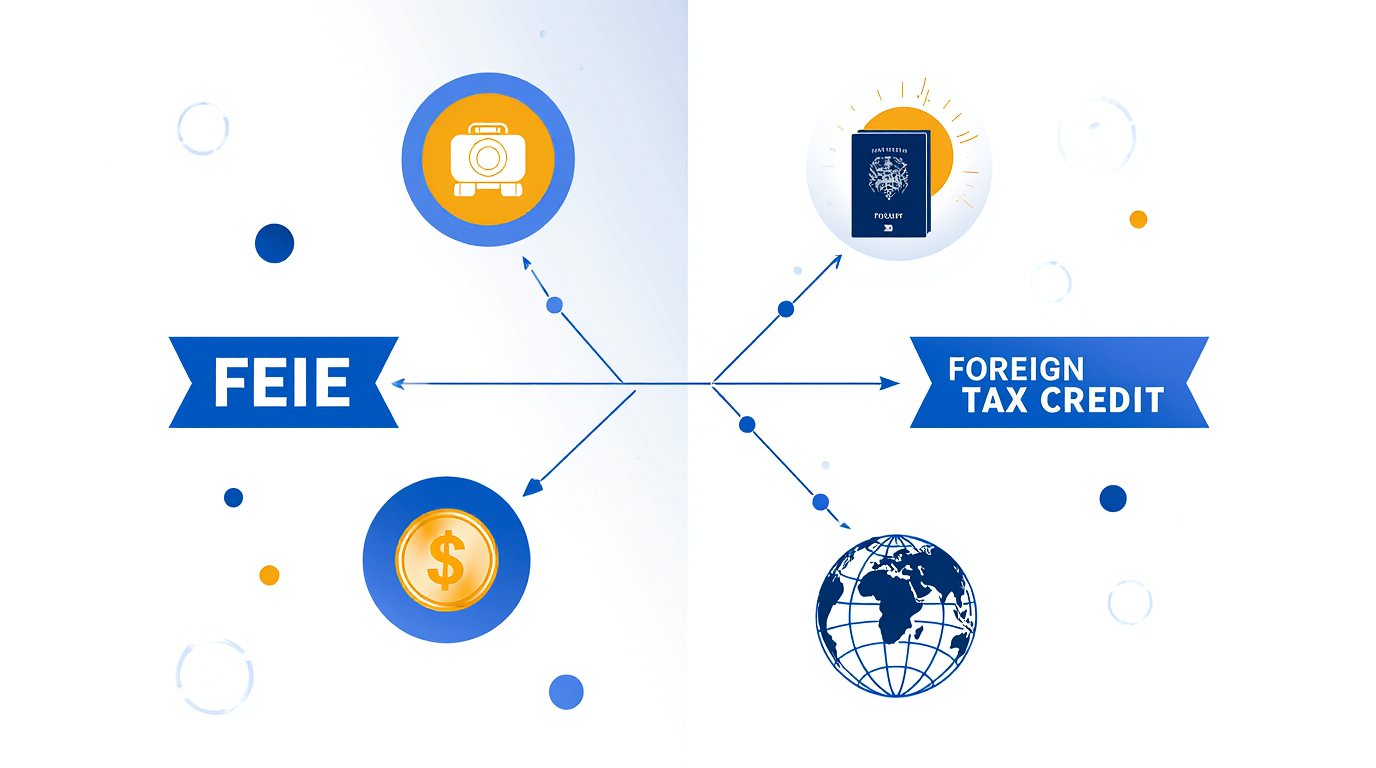
FEIE vs Foreign Tax Credit are two main ways to avoid double taxation for US expats.
Both are designed to reduce or eliminate your U.S. income tax, but they work differently — and choosing the wrong one can cost you thousands.
Read also “What U.S. Expats Need to Know About the Foreign Earned Income Exclusion (FEIE) — 2025 Update“
Understanding FEIE vs Foreign Tax Credit
1. Understanding FEIE
The Foreign Earned Income Exclusion (Form 2555) lets you exclude up to $130,000 of foreign earned income for the 2025 tax year.
You qualify by passing one of two tests:
-
Physical Presence Test: 330 days abroad in a 12-month period
-
Bona Fide Residence Test: Resident of a foreign country for a full tax year
FEIE applies only to earned income — wages, salaries, or freelance work — not to dividends, rentals, or capital gains.
Pros:
-
Simple and powerful for those with modest income in low-tax countries
-
Reduces taxable income to zero for many U.S. expats
-
Can include housing exclusion for expensive foreign cities
Cons:
-
You lose access to some tax credits like IRA contributions and EITC
-
You still pay self-employment tax if you’re self-employed
-
Once revoked, you can’t re-elect FEIE for 5 years
2. Understanding the Foreign Tax Credit (FTC)
The FTC (Form 1116) gives a dollar-for-dollar credit for foreign taxes paid.
If you pay higher taxes abroad than you would in the U.S., the FTC often eliminates your U.S. tax liability completely.
Pros:
-
Works for all types of income, not just earned income
-
Often better for expats in high-tax countries like Germany
-
Unused credits can be carried forward 10 years
Cons:
-
More complex calculations
-
Doesn’t reduce your Adjusted Gross Income (AGI) like FEIE
-
Requires tracking of all foreign taxes paid and income categories
3. Simple Decision Tree FEIE vs Foreign Tax Credit
Here’s how to choose:
| Situation | Recommended Option |
|---|---|
| You earn less than $130,000 and live in a low-tax country | FEIE |
| You earn more than $130,000 or pay high foreign taxes (e.g. Germany) | FTC |
| You have passive income (investments, rentals, pensions) | FTC |
| You’re self-employed and pay into foreign social systems | FTC |
| You’re a remote worker in a no-tax jurisdiction (like UAE) | FEIE |
Some expats combine both — FEIE for active income and FTC for the rest — but careful calculation is key.
4. Common Example
Let’s say you live in Germany and earn $100,000 USD.
-
Under FEIE, you exclude the full amount — no U.S. tax, but Germany taxes you heavily.
-
Under FTC, you report all income but claim credit for German taxes paid. Since German rates are higher, your U.S. tax liability is zero.
However, if you live in a country with no income tax (like UAE or Qatar), FEIE will save you far more.
5. The Hybrid Strategy
Many expats use a hybrid approach:
-
Exclude the first $130,000 under FEIE
-
Apply FTC for remaining income or for income that doesn’t qualify (like investments)
This requires careful coordination to avoid double counting.
6. Final Thoughts
Choosing between FEIE and FTC is one of the most important decisions for U.S. expats, contractors, and digital nomads abroad.
The best method depends on your income type, country of residence, and tax treaty benefits.
At USA Tax, I run both scenarios to find which gives you the maximum refund and minimum stress — so you can focus on life abroad, not IRS forms.
If you cannot decide which one you should file, everything seems too confusing and you feel completely lost navigating throug the forest of thousands of form, you are not alone! Lets have a free 15 minute call and I will help you not only clarify all your condusions, but also simplify everything in a simple no-robot language. No obligations afterwards! If you decide to continue working with me as your Tax Preparer, I will be happy to help you, if not – no hard feelings.
Leave a Reply